Where to Install Smoke and CO Alarms: A Room-by-Room Guide for BC Homes
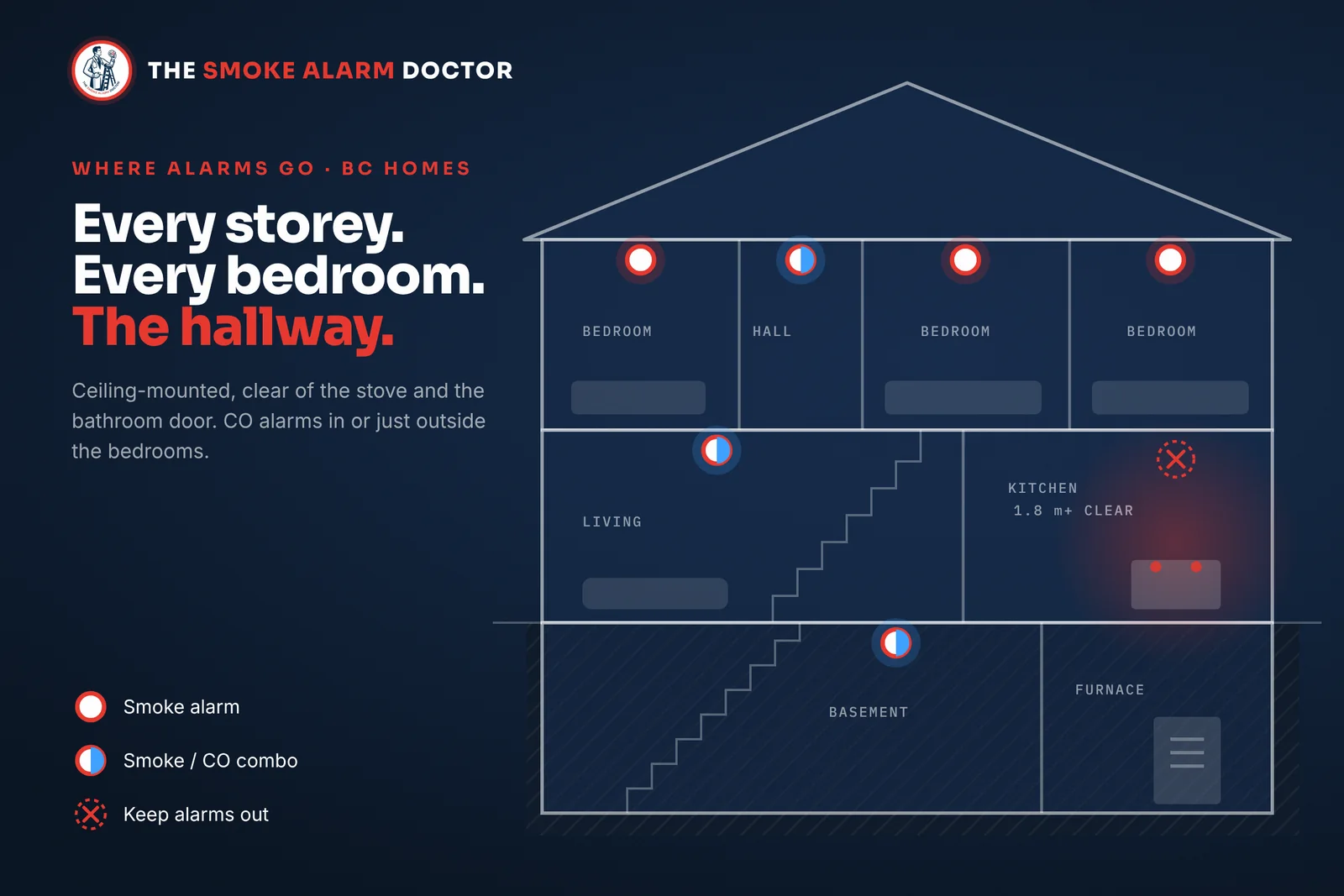
Put a smoke alarm on every storey, including the basement, in every bedroom, and in the hallway outside the bedrooms. Mount it on the ceiling, away from the stove, the bathroom door and air vents. If your home has gas appliances, a fireplace or an attached garage, add CO alarms in or just outside the bedrooms. A smoke/CO combo alarm covers both jobs.
That's the BC Building Code layout for new and renovated homes, and it's what I aim for in every home I work on. Rules for older homes vary by city (Vancouver, for one, requires CO alarms in existing homes with gas appliances or an attached garage), but every BC home must have working smoke alarms, and this is the layout worth working toward. Here's how it plays out room by room.
Room by room
| Room | Smoke alarm? | Why |
|---|---|---|
| Each bedroom | Yes | Required in new and renovated homes. Many fatal house fires start while people are asleep. |
| Hallway outside the bedrooms | Yes | It's your escape route. In a long hallway (over about 9 m / 30 ft), one at each end. |
| Every other storey | Yes, at least one | Including the basement. On a floor with no bedrooms, near the stairs going up works well. |
| Living room | Often | Covers that storey if there are no bedrooms on it. Keep it clear of the kitchen. |
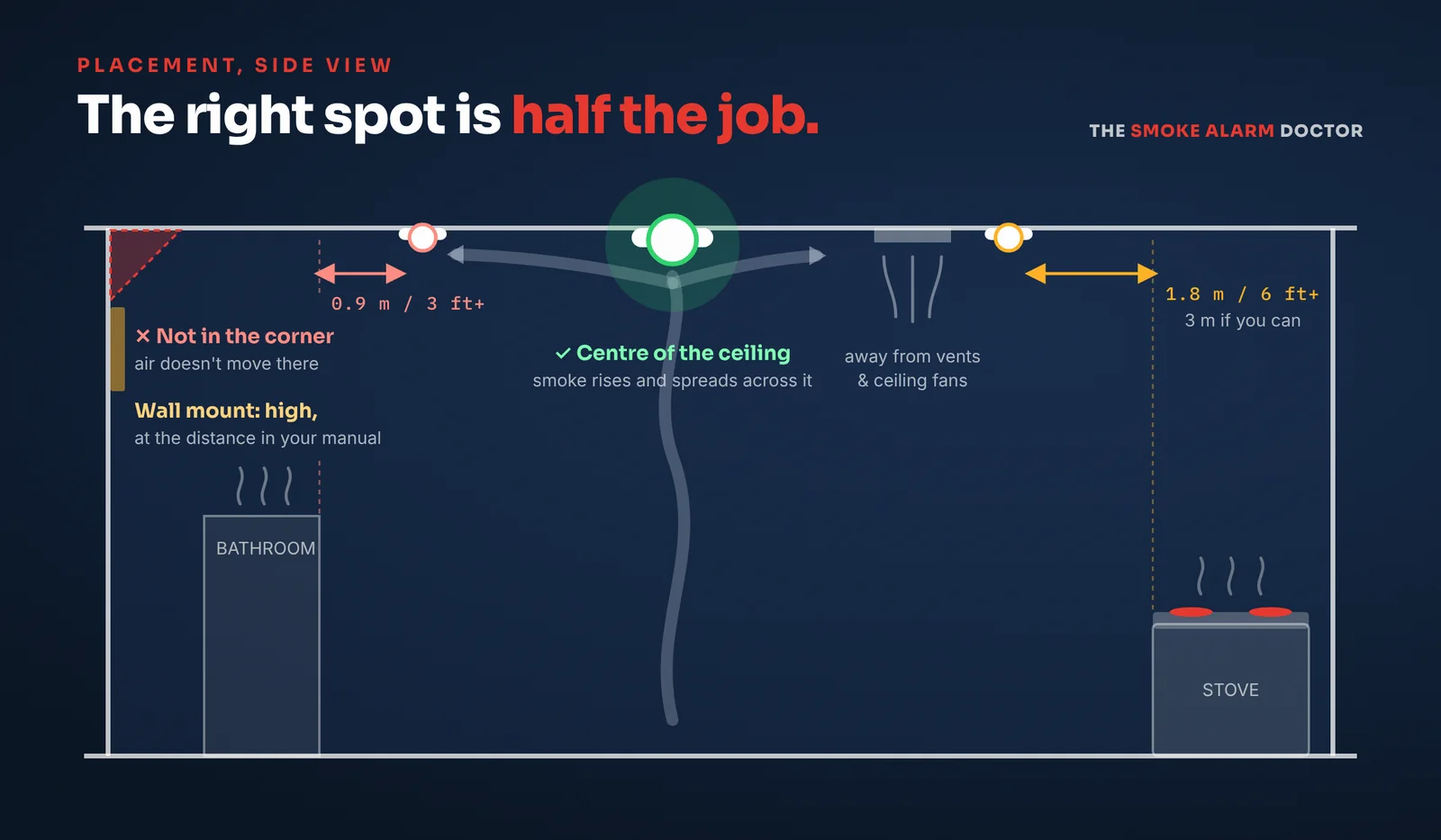
| Kitchen | No | Cooking causes false alarms. Keep alarms about 3 m (10 ft) from the stove; 1.8 m (6 ft) is Kidde's minimum. |
| Bathroom | No | Shower steam sets alarms off. Keep them at least 0.9 m (3 ft) from a bathroom door. |
| Furnace or utility room | No smoke alarm right beside it | Keep smoke alarms 1.8 m (6 ft) from heating appliances. A CO alarm on this level is a good idea. |
| Garage | No | Car exhaust sets smoke alarms off. |
| Attic or crawlspace | No | Too hot, cold and dusty for the sensor. |
How many smoke alarms does a typical home need?
Count floor by floor. Here's how it usually works out in Lower Mainland homes built or renovated to current code:
- One-bedroom condo: 2. One in the bedroom, one in the hallway or living area outside it.
- Two-storey townhouse, 3 bedrooms upstairs: 5. Three bedrooms, the upstairs hallway, and the main floor.
- House with a basement, 3 bedrooms upstairs: 6. Three bedrooms, the upstairs hallway, the main floor and the basement. That's our Full House package: 3 smoke/CO combos + 3 smoke alarms, installed, from $579.93 (BRK / First Alert) or $639.93 (Kidde) before GST.
- House with a basement suite: add the suite's own bedrooms, its living area, and any shared laundry or hallway. Depending on the fire separation between the suite and the main home, they may all need to be photoelectric and interconnected across the whole house.
Count your home's alarms
Set your home's layout. This gives the typical count for a home built or renovated to current code; I confirm it on site.
For the rules behind these numbers, see BC smoke alarm laws 2026.
Ceiling or wall?
Ceiling, near the middle of the room, is the best spot. Smoke rises and spreads across the ceiling, so that's where it reaches the sensor first. Kidde's manual calls the centre of the ceiling the preferred location.
- Wall mounting is allowed by some manufacturers. Mount it high, near the ceiling, at the distance your model's manual gives (Kidde's manual allows up to 30 cm / 12 in below the ceiling in some installations).
- Sloped or vaulted ceilings: within 0.9 m (3 ft) of the highest point.
- Not tucked into the corner where the wall meets the ceiling. Air doesn't move well there.
- Not right beside a vent, ceiling fan, window or door, where moving air can push smoke away from the sensor. Kidde also says to keep alarms away from light fixtures.
A badly placed alarm gets disabled. An alarm that screams every time someone makes toast ends up with its battery out, and a disabled alarm protects no one. Getting the location right is half the job. If you keep getting false alarms, a photoelectric alarm in the right spot fixes most of them.
Where do carbon monoxide alarms go?
CO alarms are required in new homes that have a fuel-burning appliance (gas furnace, water heater, range, fireplace or wood stove) or an attached garage. They go inside each bedroom, or within 5 metres of each bedroom door, measured along the hallway. That way the alarm is close enough to wake you.
- Vancouver goes further: its Fire By-law applies the CO rule to existing homes too, including units that share a wall or floor with a parking garage. Other cities have their own rules, so check yours.
- Kidde also recommends a CO alarm on every level, especially any level with a fuel-burning appliance.
- A CO alarm only senses the gas at its own sensor, so one alarm in the basement won't protect the bedrooms upstairs.
- In a house with a secondary suite, CO alarms must be interconnected across the whole house, just like the smoke alarms.
The easiest way to cover both: a smoke/CO combo alarm in the hallway outside the bedrooms. It counts as the hallway smoke alarm and covers the CO rule, as long as it's within 5 m of every bedroom door. The bedrooms still need their own smoke alarms. More detail on our CO alarm installation in BC page.
Placement mistakes I see most often
- No alarm in the basement, often in homes where the basement was finished later.
- An alarm in the kitchen or right at the kitchen doorway, usually an old ionization unit with its battery pulled.
- Bedrooms added in a reno with no alarm in them.
- A suite and main house that don't sound together, the most common fail when legalizing a basement suite.
- CO alarm only by the furnace, nowhere near the bedrooms.
If the alarms themselves are getting old, here's what a replacement visit involves.
Not sure your alarms are in the right places?
I walk through every storey, check placement, count, age and interconnection, test every alarm, and tell you plainly what's missing. $99.99 flat service fee, evenings and weekends at no extra charge, across Vancouver and the Lower Mainland. Here's what's included in smoke and CO alarm testing.
Book a placement check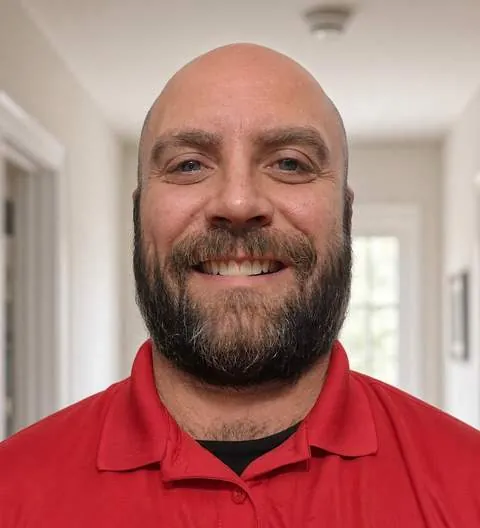
15+ years as a fire alarm technician, trained in fire alarm systems at BCIT. Licensed, insured and veteran-owned. I do every job myself, and we have 100+ five-star Google reviews.
Frequently Asked Questions
Where should smoke alarms be installed in a BC home?
How many smoke detectors do I need?
Should a smoke alarm go on the ceiling or the wall?
How far should a smoke alarm be from the kitchen?
Where should a carbon monoxide alarm be installed?
Can a smoke alarm go in a garage?
Sources
- BC Building Code 2024 (Articles 9.10.19 and 9.32.4)
- City of Vancouver — Carbon monoxide alarms
- City of Vancouver — Smoke alarms
- Kidde 30CUA10 smoke/CO alarm user guide — installation locations
This guide explains the rules in plain language; it isn't legal advice. Your municipality may have extra requirements, and your local fire or building department has the final word.
Related Articles
We install and replace smoke and CO alarms across the Lower Mainland, including Vancouver, Burnaby, Richmond, Surrey, Coquitlam, New Westminster, North Vancouver, Maple Ridge, Langley. See current prices.